
Completion doesn’t mean competence
You know 10,000 workers completed the training. You don’t know if any of them can spot the hazard on Tuesday morning. Assessment closes that gap — it turns a completion metric into a readiness signal.
Hazard Spotting
This assessment-style game drops workers into a scene and asks them to find what’s wrong — under time pressure, with the same workplace shortcuts and rationalisations they hear on site every day. The results tell you exactly which rules are sticking and which aren't.
You know 10,000 workers completed the training. You don’t know if any of them can spot the hazard on Tuesday morning. Assessment closes that gap — it turns a completion metric into a readiness signal.
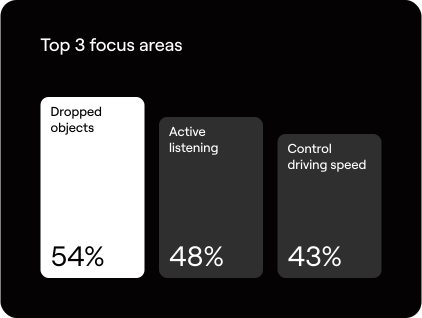
Every missed hazard in the game is a missed hazard that could happen on site. The results show you exactly which topics, which hazard types, and which crews need reinforcement — before reality runs the test for you.

Why retrain everyone on everything when you can identify the specific gaps? Hazard Spotting results feed directly into targeted training recommendations — so you focus time and budget where they actually matter.
Watch. Spot. Learn.

Workers are dropped into a realistic 3D scenario — a walkway at height, a lifting operation, a confined space. The scene plays out in real time. Dialogue reveals the context: shortcuts being taken, procedures being skipped, competence being assumed. Just like a real shift.

The worker scans the scene and identifies every violation they can find. A damaged sling. An improper sling angle. A rigger standing in the wrong zone. An operator working outside their authorisation. Each hazard maps to a specific life-saving rule.

Every hazard the worker misses triggers a Learning Point — a clear explanation of what went wrong and why it matters. "The worker should have secured the wrench to prevent dropped objects." The game doesn't just test — it teaches in the moment of failure.

The scorecard doesn't just say "44% identified." It says: Safe Mechanical Lifting — well done. Confined Space — needs more practice. That specificity is what makes it actionable. You don't retrain everyone on everything. You retrain the crews who failed Confined Space hazards on Confined Space.
Receive training recommendations based on knowledge gaps identified through Hazard Spotting. Address those gaps with immersive scenarios rooted in critical Life-Saving Rules.


Workers see their own hard hats, hi-vis, gloves, and safety gear — not generic equipment from a stock library. Your company logo, colours, and visual identity throughout.

Training set in environments that match your actual sites — your facility layout, equipment types, weather conditions, and terrain. A refinery crew trains in a refinery. A construction crew trains on a construction site.

Scenarios aligned to your specific life-saving rules, permit-to-work processes, and standard operating procedures. The rule language, the control hierarchy, the escalation steps — all matched to what your workforce is expected to follow on site.

On-screen text, instructions, signage, and voiceover adapted to your organisation's terminology and tone. Workers hear and read the language they actually use.

40+ languages available. Same programme, same standard, native language for every worker. One consistent training experience across every region you operate in.

We can build new immersive modules around your specific risks, scenarios, and standards. Scoped, scheduled, and developed to the highest standard.


